
IMAGINARIUM: A Social Imagination Experience
In 1900, W.E.B. Du Bois, historian Daniel Murray, and librarian Thomas J. Calloway exhibited at the World’s Fair in Paris, celebrating global achievements that looked back over the past 100 years while incubating ideas that would mold the future. The Exhibit of American Negroes was a display that showcased the humanity, diversity, and experience of African Americans at the turn of the century.
Over the past three years, we have seen our world shift in ways we never thought; the IMAGINARIUM is a way that Black people can curate their vision, hopes, and ideas to be displayed for the world to see.
The IMAGINARIUM is an experimental and interactive exhibition of social imagination. It provides a space for visitors to share their vision for the feature of Black Baltimore; Black D.C., Maryland, Virginia (DMV) Region; Black America; and the Diaspora. In conjunction with our theme Black futures/Black imaginings, the exhibit asks a series of prompts and scenarios of visitors through engaging design activities that encourage creative brainstorming for the future.
The investigative prompts that the IMAGINARIUM asks discuss topics that impact the visitor as an individual and a member of the Black Community. The IMAGINARIUM discusses socio-economic issues: mental health, nationalism, education, public safety, the workforce, community spaces, and the arts.
BACKGROUND
The IMAGINARIUM is birthed from the theme Black futures/Black imaginings, which is an effort to explore the concept of Black futurism as an imaginative and liberatory practice. Black Futurism, Afro-Futurism, Astro Blackness, and its other names center themes of liberation for Black people, reclamation of self and culture, and imagining the future. Afro-Futurism is frequently framed in a fictional, technoculture, and speculative narrative; the IMAGINARIUM will be a space that centers the visitor’s voices through an afro-speculative lens using history, interactive visual design, and mind-mapping.

NEA ONNIM NO SUA A, OHU: HE WHO DOES NOT KNOW CAN KNOW FROM LEARNING
VISITOR LEARNING OUTCOMES
The IMAGINARIUM is a space where collective imagining and dreaming happens; reading the response of others is a learning experience for each participant. The anwers shared amongst visitors, paired with statistics about our current climate and the 19th century, inform visitors and allow them to measure past generations’ efforts.
The IMAGINARIUM provides space for visitors to have a say in the direction and representation of themselves; when future generations look back on past responses, they can see a snapshot of the events, topics, and dreams we once had.

The Lewis Now Gallery has been transformed into an immersive think-tank. The 1900 minimalistic infographic style of The Exhibit of American Negroes has been infused with the blue hues of Yoruba cosmology and the bold, simplistic graphics of Adinkra symbols.
The intention of using hues, design, and symbolism of the African and African-American ancestors connects to Sanfoka, which means to learn from the past. Black futures/Black imaginings is a look into the futures of Black people as individuals and a collective which cannot be done properly if the past is not first examined. The IMAGINARIUM‘s purpose is to encourage participants to dream big, which is only made possible by the sacrifices of those before us who dared to dream.
The IMAGINARIUM observes what happens when Black people as a body have the space and freedom to design their future.
AUDIENCE
The IMAGINARIUM is geared toward an intergenerational audience. Planning, dreaming, and imagining a better future must be equitable and includes voices from varying generations. The exhibition is an interactive space with bold visuals and interpretative text; it allows audiences with diverse learning abilities to share their vision, ideas, and thoughts in ways most comfortable for their learning experience.
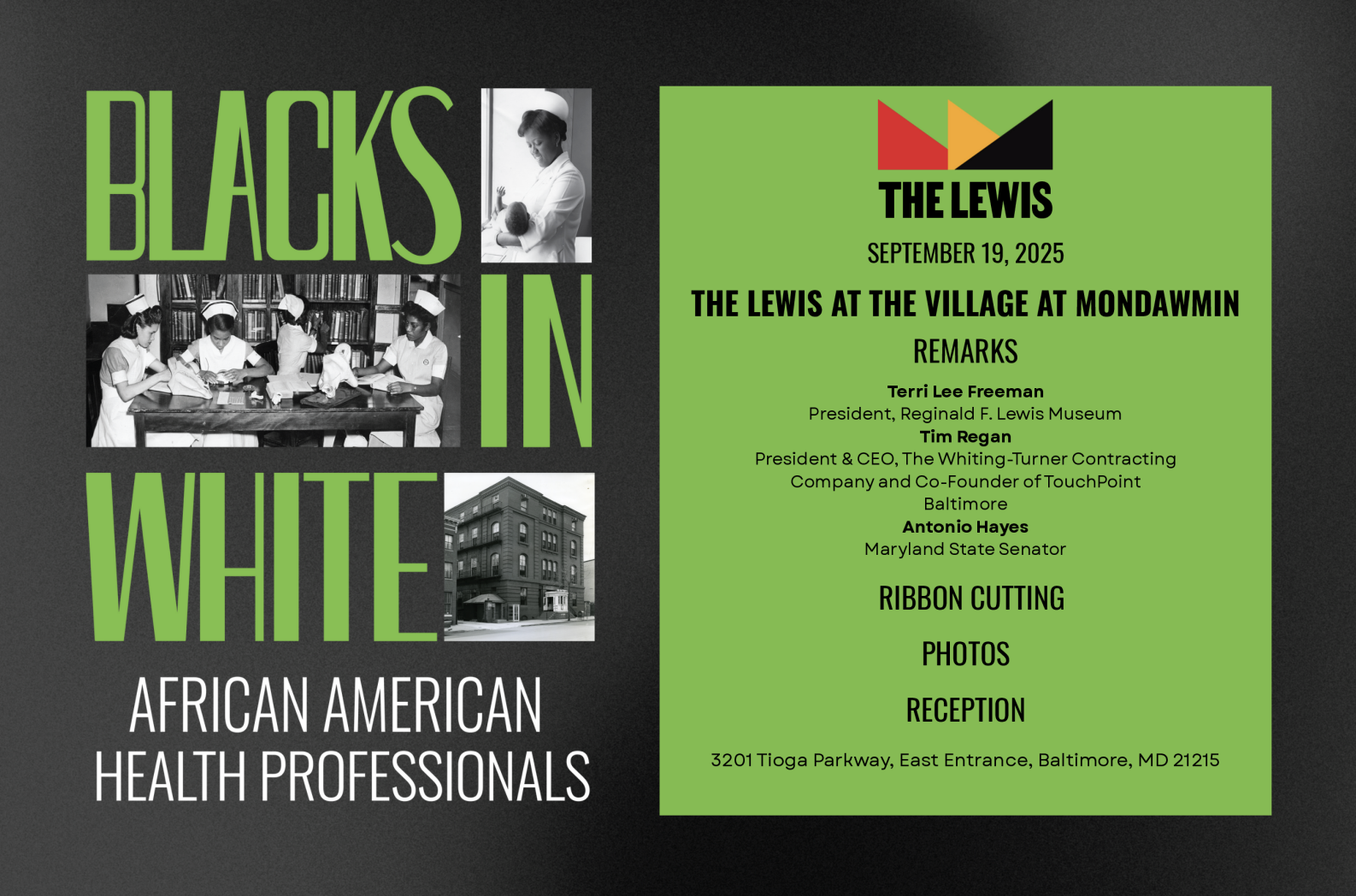
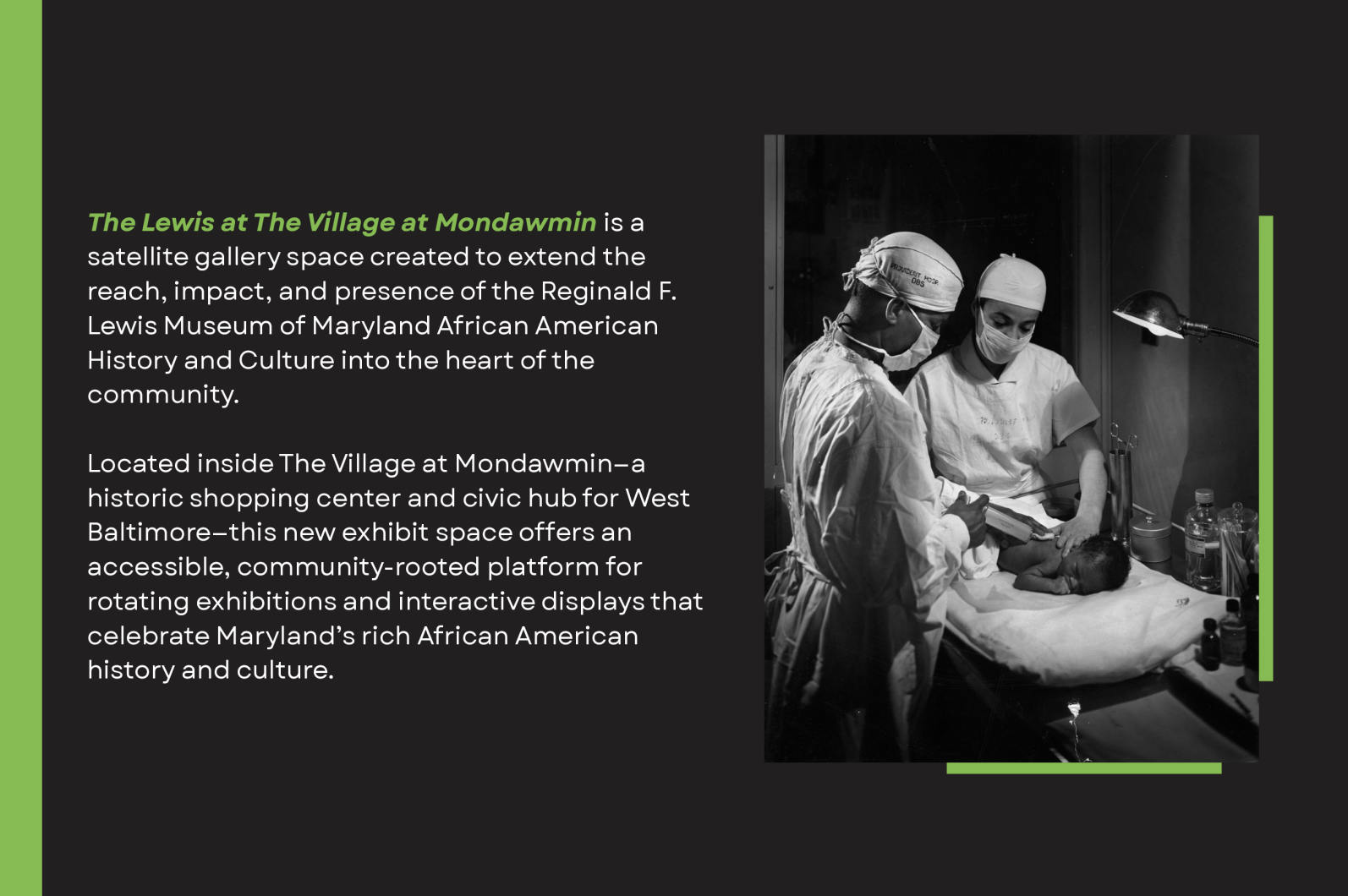
The Reginald F. Lewis Museum is proud to announce the opening of its newest touchpoint satellite gallery exhibition on September 19, 2025 at The Village at Mondawmin!
Blacks In White: African American Health Professionals is a powerful exhibition that highlights the extraordinary contributions of African American health professionals whose dedication, innovation, and service transformed the field of medicine and enriched our communities.
Location: The Village at Mondawmin, 3201 Tioga Parkway – East Entrance, Baltimore, MD 21215
We invite you to explore the stories, images, and artifacts that shed light on a legacy of excellence in health care that continues to inspire generations. The satellite exhibition is now on view and open to the public. Stop by The Village at Mondawmin and experience this important celebration of history and healing.
Join us as we honor the strength, resilience and brilliance of Black health professionals